Thursday, May 5, 2011

Sightseeing in the Schwabian Albs

The Heritage Tour portion of my trip has ended and today we spent the day sightseeing. It was still mostly historical sites so I guess that counts! 

The day started off on a low note because Willi's wife Monika hurt her knee and was not able to join us. So it was just Willi and me. We started the morning off with a visit to the Festungsruine Hohenneufen, which means the ruins of the Hohenneufen Castle.This midieval mountain castle was built around 1100. It stands high above the plains of the Schwabian Alb. The castle ruins are in remarkably good condition considering they are almost 1,000 years old You can read more about the castle here.


Three Billy Goats Gruff?

After wandering around the castle for awhile, we went to an open-air museum that had actual buildings from the villages in the area from the 18th century that had been moved to the museum.  It was beautiful day and we wandered from building to building and were easily able to imagine what life had been in these villages for our ancestors.  

One of the buildings was a small house, called a Tagelöhnerhaus (Day Laborer House). This particular Day Laborer House was built in 1734 and was one of five that were originally located on the outskirts of Weidenstetten.  This was of particular interest to me because my 3rd Great Grandfather, Jakob Braun, was a Tagelöhner (day laborer) and he lived in Weidenstetten before marrying Margaretha in 1823.  It is very possible that Jakob lived in one of these five Day Laborer Houses!  


A picture of the five houses before they were moved


the restored Day Laborer House

From the Museum Tour Guide
Another interesting display was a Schnecktengarten, or a Snail Garden. They raised snails and sold them as a delicacy. 


Then it was time for lunch. We had a nice lunch at the museum's outdoor patio. Since it was the middle of the week there were very few tourists, with the exception of a school field trip. So we had the patio to ourselves. There was only one waiter on duty and just as we finished eating, a small group of about 4 young boys from the school group ran up wanting ice cream. So the waiter went to help them.  A few minutes later, 4 or 5 more kids came running up, then 5 more, then 5 more... next thing you know, there were about 45 or 50 young kids lined up all around us waiting to buy ice cream. While we sat waiting for our waiter to bring us the bill. Finally Willi stuck his head inside the building and asked if the waiter could take a break from selling ice cream and bring us our bill. 

Lunch was a soup made with mushrooms and a German dumpling spiced with Spring Onions. It tasted wonderful!


After lunch it was time to move on to our next destination. We visited a small town called Blaubeuren. In this town is located a natural spring that draws its water from underground caves. Because of the chemical properties of limestone, the water is a beautiful blue color. ("blau" in German).  The water from this Spring flows into the River Danube in the City of Ulm. http://en.wikipedia.org/wiki/Blautopf


The church on the other side of the Spring is the Blaubueren Abbey. Once a Catholic Monastery, the Monks were expelled during the Reformation in 1535 and a Protestant choir school was opened in 1565. In 1817 it became a Protestant Seminary with an attached boarding school. 


Next we drove to the City of Ulm, which is where I will be driving tomorrow to return my rental car and catch the train to Nuremberg. Willi took me to the train station to purchase my ticket and we walked around to see where the car drop-off is located, and where I will need to go to catch the train. Then we visit the old town area. This is one of the few areas in Ulm that was not destroyed during World War II. 

The Ulm Minster is probably the most famous site in the city. Ulm Minster is a famous example of Gothic ecclesiastical architecture. Like Cologne Cathedral, also begun in the Gothic era, Ulm Minster was not completed until the 19th century. It is the tallest church in the world, and the tallest structure built before the 20th century, with a steeple measuring 538 feet and containing 768 steps. From the top level at 469 ft there is a panoramic view of Ulm.  The final stairwell to the top (known as the third Gallery) is a tall, spiraling staircase that has barely enough room for one person. Needless to say, we did not climb the steeple!! 


We walked around the old town and looked at the old buildings and then went to the top of one of the newer buildings for coffee (hot chocolate for me) in their outdoor patio, and then returned to Gussenstadt for a nice dinner and visit with Monika and Daniela, Willi's wife and daughter. 


I can't believe that my time here has come to an end, and tomorrow I will be leaving here to begin the second leg of my adventure. Tomorrow night I will be in Nuremberg and on Saturday afternoon I will be boarding the Uniworld River Countess for a seven day Rhine River Cruise. 


Wednesday, May 4, 2011

Birds for my Brother

My brother the birdwatcher and nature photographer asked me to take some pictures of birds in Germany. I've seen a few, but haven't been able to get close enough to get pictures. But today we visited a museum in Gussenstadt that had a display of birds and other wildlife. So, Dan. Here are your German bird pictures!


Journey to the Villages of my Ancestors

Today was another amazing day. We visited the Protestant Church in Lonsee where our ancestors attended in the late 16th and early 17th century. The Reverend from the church met us and let us go inside and look around. Once again, the baptismal pillar from centuries ago was still in use.

The paintings on th wall near the back are part of the original church from the 1400's
Next we visited a village called Bernstadt, where our oldest known ancestor lived in the late 1500's. We went to castle that had been renovated into a museum and city hall. In the museum they had the original hand-written church record books that had been maintained by the pastors of the church since time that our ancestors attended. The Historian took us on a tour of the museum and showed us the church books. He was very knowledgeable about the history of the area. He told us based on the information they had, the Braun family that lived in Bernstadt were from a nearby town called Osterstetten AND that the records show that the Braun's from Osterstetten were Romans!

Looking through the church books for Brauns
After lunch we drove past the church in Weidenstetten, where Leonhard Braun's father was born and lived before going to Aufhausen to marry Margaretha. Then we drove through Ettlenschiess, Where Leonhard's mother's family lived for over a hundred years, and to Stubersheim, another town where Braun ancestors lived.

The church in Weidenstetten
A restaurant in Stubersheim

On our way to the next village we stopped to see a natural spring, and an archeological site. According to the explanation, this area of the Swabian Alb was under the sea about 20 million years ago. The archeologists found fossils in a rock bed that they have determined were from when this area was under water.


The little holes in the rock are where the fossils


Archeologists believe the "shelf" on this rock was created by the sea 

In Gerstetten, we went to the top of the water tower and took some amazing pictures of the Swabian Alb countryside and forests. Then it was time for a break so we stopped and had ice cream and Willi showed me the exact spot where my ancestor Heinrich Mueller's house was located based on the city archive records. The spot is where the ice cream shop is now located, but the City Hall still exists, and would have been right outside the Mueller's window!

A view of the Swabian Alb from the water tower in Gerstetten

No this is not spagetti! It is "spagettieis (pronounced spagetti-ice) and it was amazing!
You can read about it here! http://en.wikipedia.org/wiki/Spaghettieis 
The Old City Hall in Gerstetten taken from the spot that would have been Heinrich Mueller's house

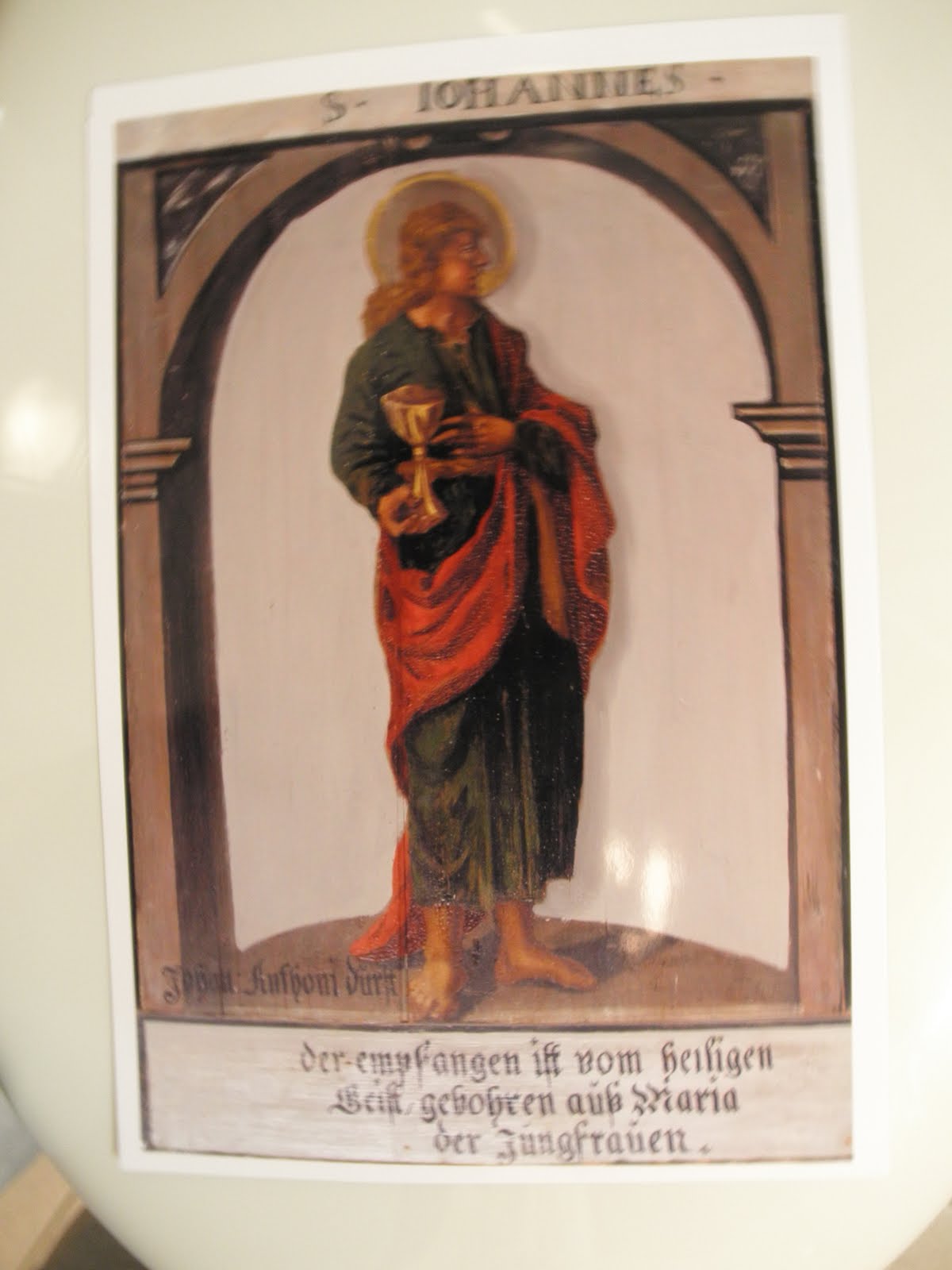
Our next stop was Gussenstadt. This is also the village where Willi lives. We visited the church where our common ancestors attended.  (Remember at one branch of our family tree, he and I share common ancestors, the Staudenmeyers and Dursts.) This church originated in the 1100's.  On the wall of the balcony there were paintings of the twelve apostles. On most of the paintings there was a name written, which was the name of the parishoner that donated the painting to the church.  Two of these paintings had our ancestors names written on them!

The church in Gussenstadt.  See the Paintings that are lining the balcony!
It's hard to read but to the left of his feet it says Johan Anthoni Durst
our 7th Great Grandfather, born 1662 and died in Gussenstadt 1708

To the left of his feet it says "Christ und Jerg" (Christian and Georg)
To the right of his feet is written "Staudenmayer".
 Jerg was also our  7th Great Grandfather, born 1659 and died 1732 in Gussenstadt

After visiting the church, we went to a museum where Willi used to work, and then to his house to meet his family and have dinner. We had such a wonderful visit with them! Then it was time to return to the hotel for the night.  

Sadly, I had to say goodbye to Mrs. Löffler tonight. Spending the last two days with her has been amazing, I can't even imagine what it would have been like if she hadn't been there to translate and explain things to me. I learned that she will be 90 on her next birthday, and she worked for 30 years for the German Embassy, in Indonesia, Tokyo, and several other countries. She had so many amazing stories to tell. I will miss her for the remainder of my time here. 

But tomorrow is another day, and we have more great plans in the works. Willi's wife, Monica will be joining us and she lived for three years in U.S. as a child and speaks English perfectly! 


Tuesday, May 3, 2011

Today was The-Most-Amazing-Day-EVER!!

Seriously, not in my wildest dreams when I thought about coming to Germany to visit the hometown of my ancestors, could I have imagined how this day could have been better! Ok, well one thing... the weather. When I woke up this morning and looked out my window I saw a wall of fog and it had been raining. Yes, they have Tulle Fog in Aufhausen! In May! Luckily the fog cleared but it was cloudy and pretty cold all day. But not cold enough to ruin any of our plans.

This morning Willi and Mrs. Löffler came to my hotel. It was wonderful to finally meet them after all this time. We had a light breakfast and Willi presented me with a folder that had my complete German family history back to 1570. The book also contained a picture of the family home in about 1935 Aufhausen. This is the house where my immigrant ancestor, Leonhard Braun was born. Last but not least, there were photocopies of the record of his father Jacob Braun, purchasing the property in 1823. 
The house in about 1935 with Christof Reichart and family
Our first stop was the church that Leonhard's family attended. This church is over 600 years old. Mrs. Löffler was able to get the keys to the church so we could go inside even though the church was closed. What an amazing feeling to be standing inside this building knowing that my ancestors stood in that very same spot. We took a picture next to what looked like a small stone table set on a pillar. After we took the picture, she told me that the top lifts off and this is not really a table, it is a stone "bowl" where the babies were baptized shortly after birth. She said, "your ancestor, Leonhard was baptized in there". Unbelievable! 


The "table" that turned out to the the bowl where the babies were baptized


After we left the church we went to her home for a short time before driving to Geislingen.  (Geislingen the city, and Aufhausen is a small village within the city.) There we went the archives of the genealogy association and Willi showed me some more records that he had found of our ancestors. One of them was the marriage record of Leonhard's parents, Jacob Braun and Margaretha Buekle. 
At the Archive
These documents really told a story. Jacob was from Weidenstetten and Margaretha was from Ettlenschiess. Their first child, a daughter named Margaretha Braun, was born in 1820 in Ettlenschiess. Jacob and Margaretha were not yet married.  It seems that young men in Germany at this time were required to obtain permission from the King to marry, and in order to obtain permission, they had to demonstrate that they had property and would be able to provide a home for their wife and family. Three years later, in September 1823, Jacob purchased the land where the Leonhard's birth home now stands. A few days later, Thomas and Margaretha requested permission from the King to marry and permission was obtained. They posted,the required three public notices of their intent to marry, and finally on October 7, 1823, they were married in the very same church where we visited earlier this morning. 

After lunch we walked around the Old Town and saw more of the beautiful old buildings, some more than 600 years old.  


Then we drove out to a beautiful vista that overlooked the Swabian Alb mountains with two tiny villages nestled in valleys below. The view was incredible. When we left the Vista, we visited a small German bakery and were allowed to go to the back and see where the bread was made.  
Swabian Albs


Bread!

Then it was finally time to go visit the Reichart Family, my newly found cousins that still live in the house where my great-great grandfather, Leonhart was born in 1836. On the property that Jacob Braun purchased in 1823 so he could marry Margaretha. Ernst and Heidi are delightful people that welcomed me into their home like they had known me forever. Heidi baked two amazing German desserts and we sat around the kitchen table for hours talking about our ancestors, about America, and so many other things. Ernst showed me some pictures of the house as it looked when his Grandfather was a young man and the owner of the home, and several other pictures that had been taken throughout the years as renovations had been made.  Finally, their son and daughter-in-law, Oliver and my friend Marianne and their daughter Victoria, joined us and we visited for several more hours. Heidi fixed us a nice traditional swabian dinner of meats, cheeses and homemade bread. What a warm, friendly family! 

Ernst & Heidi Reichart and me 

Mrs. Loffler, Oliver, Heidi, me, Ernst, Marianne kneeling in front, and Oliver & Marianne's daughter Victoria

We finally left about 8:00 pm and returned to my hotel where I sit and wonder how anything  we do tomorrow could ever top this day!

Monday, May 2, 2011

Survived the Autobahn!

I still can't believe I'm really here in Germany. All of my flights actually arrived ahead of schedule. On my flight from Sacramento to DC, I sat next to a delightful couple from Carmichael that were on their way to Rome to celebrate their 25th anniversary. Susie's friends were waiting for me at the airport. Hans helped me get the car rental taken care of and then we drove to Ludwigsburg as planned.

We had lunch in a nice little restaurant near the palace. We all had this wonderful crepe-like dish that had white german asparagus wrapped in ham or canadian bacon inside the crepe. I don't recall what it was called but it sure tasted good.  After lunch, they took the train back to Heilbronn and I went on an English-speaking tour of Ludwigsburg Palace. What a beautiful place, and luckily it didn't get destroyed in WWII like many of Germany's historic buildings. I stood in a beautifully decorated hall where Napoleon Bonaparte had been.

Ludwigsburg Palace


King Friedrich reigned over the Kingdom of Württemberg from 1806 to 1816 

The King's bedroom


A view of part of the castle garden from inside the Palace


Then came the most dreaded part of my entire trip; the drive from Ludwigsburg to the town of my ancestors, by myself, on the infamous autobahn.  My rented GPS wasn't working because they gave me the wrong charger (I will take care of that tomorrow...) but luckily I had printed out driving directions just in case.  OMG cars were zooming past me!! Everything was going fine until we came upon a really bad accident that slowed traffic down to a crawl.  It took twice as long to get to my destination thanks to that accident.  By that time I had been awake for about 24 hours straight and as I sat there in bumper-to-bumper traffic I kept feeling my eyelids start to droop. I turned up the A/C and the radio to try and keep myself from falling asleep on the road.

I can't wait to get out and take some pictures of this place tomorrow! It is absolutely beautiful country! Aufhausen is a small village of 950 inhabitants nestled in the Schwabishe Alb and everything is so green and surrounded by beautiful hills.

For now I am safely curled up in my "hotel" for the evening.  I'm staying at a small "landgasthof" that is like a bed & breakfast inn, and only has about 6 or 7 guest rooms. This building was built in 1637 as part of an agricultural operation. Here is a link to the history http://roessle.wordpress.com/geschichte-3/. It's in German but at least you can see pictures!